January 8, 2015

Beginning Keeping

Within the Ambleside Online and Charlotte Mason community, last year the art of "keeping" leaped into the spotlight with the release of The Living Page: Keeping Notebooks with Charlotte Mason (see also here and here).  I used to be a Keeper, but when life got busy, it went to the wayside.  Some positive peer pressure on the AO forum has me taking another look at the keeping way of life, and I'm determined to make a go of it again.

As Brandy suggested, I'll be adding notebooks slowly to my life so I won't overwhelm myself, or my son, who will be tagging along for his own education.  As he nears AO year 4, his own note booking is about to begin in earnest, so I'm going to lead the way.

I already have a journal for dumping my thoughts, but don't use it very often.  That's okay, its there when I need it, and its feelings aren't hurt when I leave it in a drawer.  I also started a prayer journal last year, with the intention of writing down requests as they came to me, praying over them regularly, then putting down the dates they were answered.  Oops - that fell to the wayside as well.  I will be picking that one back up, but not posting about it here, as that is a very private notebook.

So, for 2015, I plan on adding to my private and prayer journals the following:

1. Commonplace book, for keeping direct quotes from books and what-not. Started Dec. 2014 (I'm totally counting it for 2015!)
Started out as a journal when I was much younger...

Rediscovered as an adult, with many pages ripped out...
...so I decided to make it my first commonplace, knowing it was already imperfect would help me to just. do. it.

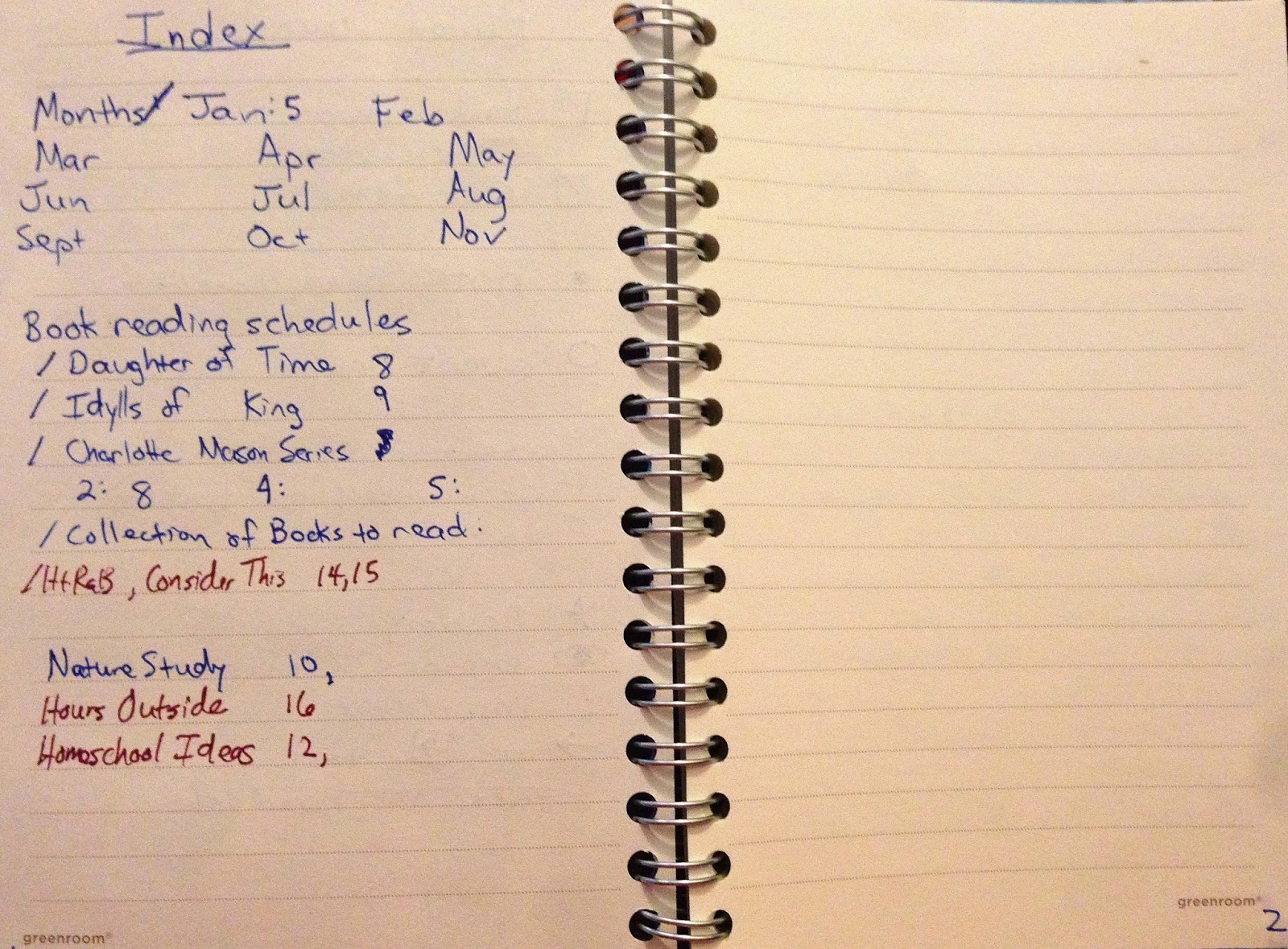
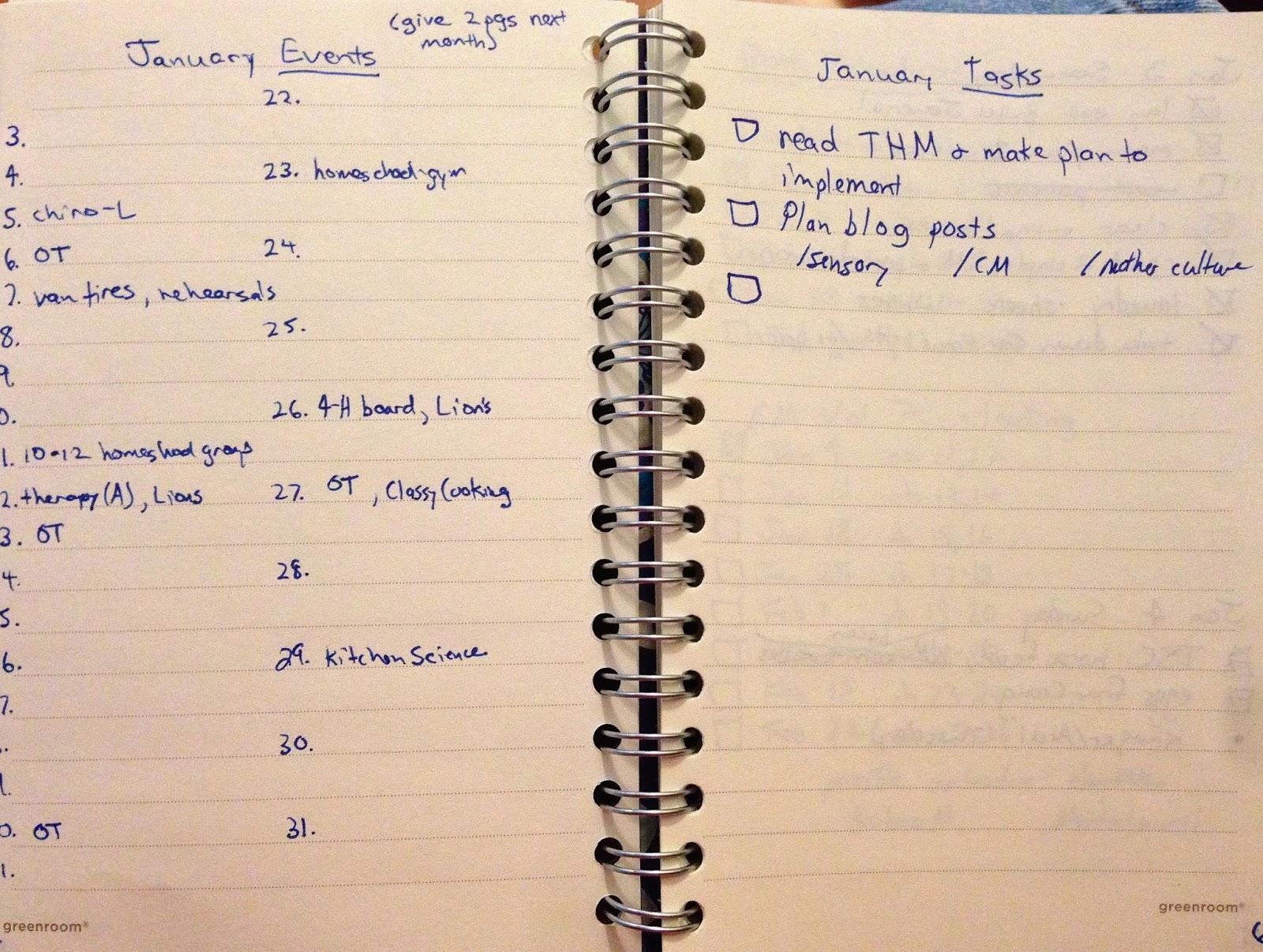
2. Bullet Journal, for keeping lists, notes, to-dos, goal tracking, and all those things I need to remember but aren't convenient in Evernote (which I use extensively already). Below are most of the pages I'm already using, by request (I'm talking to you, Dawn Girl!)  Started January 2015


3.Price Book, for comparison shopping of grocery items, to be updated at least every 6 months and adding new items regularly (bi-weekly or monthly). Example. Start goal: February 2015

4. Nature notebook, for our weekly nature walks; to include drawings and observations. Yes, we started one a few years ago, but let it slide. Start goal: March 2015

For Jan and February, I am planning on tracking the weather, as that is the current nature subject on AO.  Here's what we've got going on there - he tells me what to write, or I tell him what to write, so he participates each time in some way.


5. Book of  Centuries, which has a goal of one entry per week of an item, person or event that strikes me as important for a particular year in history.  I'm considering one of these  for both my student and myself.  Until then, we will get in the habit of adding to our timeline. (What is a BoC?) Start goal: September 2015

Most were inspired by the ladies over at AO and/or Charlotte Mason.  The price book comes from trying to be more frugal and eat healthier simultaneously, and I've seen it suggested many places over the past few years so am not sure who to attribute that one to.

My goal is to post once or twice a month with photos of our notebook keeping efforts, and to join in the link-up here.  If this is something you'd like to start to help your mind and soul keep growing, join us!

December 9, 2014

The Need to Chew is Real

My son is a chewer.  He chews bubble gum as often as he can, since his therapist nearly 2 years ago said to let him have it.  (I'm not sure the dentist would agree, as the sort of gum that gives good resistance to the jaw does not come in sugar-free!)  When he is anxious or stressed, the need to chew increases, sometimes dramatically, and can escalate to biting when he's over-the-top melting down.

He has always been orally different.  As a baby he never sucked his thumb or would take a pacifier.  He rarely put anything in his mouth.  I thought he was just smarter than other babies or something (he was my first, after all, LOL), but now I know those were signs of his oral issues (see the previous post on Feeding Therapy).  I'm not a therapist, and am not sure how he went from not wanting anything in his mouth to chewing on so many things, sucking on clothing, yet still being a picky eater.  But I do know its all related.

Is this need to chew related to sensory processing disorder (SPD)?  Absolutely.  The muscles in the jaw are where much of the tension in our body is stored, and the proprioception of hard chewing is an excellent release of that tension.  (This is also one reason why we stress eat!)  The trick is to find something to satisfy this real need while not destroying things are gaining too much weight.

We keep a variety of objects and foods on hand to satisfy his need to chew.  The hardness, crunchiness and tartness are important for either causing alertness or calming him down.  Since I homeschool him, he can have these things any time, although I've learned that if I do  most of the seat work during meals and snack times, he can get through most of school with just a bit of gum now.  Quite an improvement over a couple of years ago!


Lemonheads are great for alerting, as they are sour and require sucking for a time.  Calming foods include crunchy pretzels or chips, or really chewy things like Fruit Roll-ups (but my son doesn't like the gummy texture of such things).  Double Bubble is both alerting and calming, which is why its our go-to item.    Beyond food, we have special eraser tops, P-chews, and Camelbak water bottles (all recommended at asensorylife.com).

When his body and emotions are in a good place for doing school work, I make sure he has other therapy objects for his hands to manipulate.  During math, its the abacus.  During read-alouds, its Theraputty, Legos, something to draw with (usually a pen, so he can take it apart and reassemble), a tape measure, yarn, clothes pins, or shape-changing toys, such as a Jacob's ladder.  If I hand him something to use, he may or may not want to, but if I keep the 'fidget box' nearby, he typically will grab what he needs on his own.


Of course, if he is heading towards a melt-down due to frustration over some subject, these items and foods won't work.  They help him maintain equilibrium but can't do the heavy-lifting, so to speak.  Next blog hop, I'll discuss what we do to head off imminent meltdowns, and how he recovers if they happen anyway.


Here is another blog post that almost sounds awfully familiar, and my inspiration to share our story - Sensory Integration for Children Who Chew.  And of course, the reason for these mostly posts about SPD is the Sensory Bloggers Blog Hop!  Check them all out...


November 11, 2014

Our Journey with Feeding Therapy

My son has trouble with foods.  Since he was an infant, eating has been hard for him.  He nursed, but not really well.  He ate baby foods, but not a wide variety of them.  By the time he was eating table foods, it was a 'typical' toddler diet of chicken nuggets and some fries if we went out.  I was told it was a phase, and would get better.  I kept offering him other foods, and went through phases of 'making' him eat...you know, where you say eat one bite of each thing before you leave the table.  This does NOT work if they have sensory issues!  He would cry and carry one for an hour sometimes, and usually went to bed hungry.  If he did try the foods, he often gagged.  It didn't take long for me to realize that something wasn't right.


Of course, I blamed my parenting skills first.  I should have 'made' him eat more variety when he was smaller.  I should have...what??  Pried his mouth open and shoved it in?  Started the power struggle over food at breakfast instead of letting him have pop-tarts or cereal?  No.  Making him anxious first thing in the morning or right before bed was not and is not the answer.  Yes, people probably do blame me for his eating habits, and think a good spanking will cure him.  It won't.
Yogurt has always been a winner
I heard about sensory processing disorder (SPD)  about 3 years ago now, not long after we started homeschooling.  It explained his sensitivity to noises, lights, foods and textures!  I was confident that if I learned enough about it, I could 'fix' him.  Well... I can't, but I am still learning and have found that outside help is needed.  He will simply try things for others that he won't at home.  Sigh.

What he eats at gatherings - nothing...or bread
In my previous post, I mentioned his start in therapy, where he attended Minds in Motion.  This had an academic focus - rewire their brains and they can learn more and focus better.  Its a good plan, but not quite enough.  The year following, in 2013, he had 20 visits with a pediatric
OT locally.  She introduced feeding therapy to us, but it wasn't a big focus.  I think 3 sessions included food - once with a smoothie, and twice with trying a variety of foods in little dixie cups.  We learned the steps to learning to like a new food.  With some foods, he can skip to the final step, but others require a combination of the other steps on various days.

1.  Smell it and look at it.
2.  Sniff and lick.
3.  Bite and spit it out.
4.  Bite, chew and spit it out.
5.  Chew and swallow.
6.  Repeat up to 7/15/20 times (depending on your OT/research...ie nobody knows, really) and then
7.  He will like the food!  (maybe)

He knows the steps, and will sometimes try something now without me asking.  That's actually been the best strategy - never offer him anything new.  If he is interested, he will ask.   This eliminates anxiety for both of us.

Drinking: still his favorite restaurant activity
Now, how is the current feeding program working?  Much the same as with the previous OT, although Esther is consistent about doing the therapy each Thursday.  Instead of little cups, she prepares a paper plate with a variety of foods to try for him, and one for herself.  She lets him take the lead, choosing which food to try first.  He first tries to describe the food - crunchy, salty, etc. - then he can choose another.  After he has tried everything once, he goes back around again and finishes them up.  Even if he doesn't want to chew and swallow a particular food, he has to touch it and put it in his mouth, then spit it into the trash.  So far, he has tried everything, even though much of it does go in the trash.  So far, no current new favorite foods have surfaced, but no fits either.  I think when his 20 visits are over (per insurance rules), I should be able to recreate this process at home.  Once a week seems doable!