The Peterkin Papers {affiliate} by Lucretia Hale is a collection of short stories about the Peterkin family. It is scheduled in Ambleside Online year 4 as a "free read". I'm listening to it via Librivox.org, and they are 4 to 24 minutes long.
The names of the children strike me as funny - Elizabeth Eliza, Agammemnon, and Solomon John and two "little boys" are the siblings. The parents are Mr. and Mrs. Peterkin. :) There are other adults - the lady from Philadelphia, for one, "to whom these stories were first told." They all showed up for a tea party at once and overfilled the house! They had to improvise on finding more cups.
The children do come up with some funny ideas, and usually run into some trouble by running out of common sense, LOL. They could be a good stories for practicing problem solving with your own kids! Mr. Peterkin comes up with some interesting ideas, too, like raising the ceiling in the parlor in order to fit the too large Christmas tree instead of just cutting off the bottom of the tree. I felt sorry for Mrs. Peterkin several times as she dealt with the mess or aftermath of her husband's and children' ideas. Not that she was perfect - they went on a trip behind a horse and started out going the wrong way and she couldn't turn around, so they went a long way out of the way.
One of the craziest stories was The Peterkin's Charades. They acted out an elaborate charade with other children in front of an audience and didn't even know the word they were trying to act out until the very end! Haha!
So, if you are looking for something quick and usually funny, these are worth the read.
Showing posts with label Ambleside Online. Show all posts
Showing posts with label Ambleside Online. Show all posts
December 9, 2016

December 7, 2016
The Betrothed
I realized that I did read this for the Back to classics challenge, but forgot to post a little review. I'll do that below. (Also, reading to The Peterkin papers now to get to the 6 required for an entry into the prize drawing!)
The Betrothed (I Promessi Sposi) by Alessandro Manzoni
I loved this book. Its easily my favorite read for the year. I read along with the AO forum discussion, as this novel is scheduled in year 8, so it also counts as pre-reading! Win.
I read the Penguin Classics paperback {affiliate} - its was large and intimidating at first.
 This is the foremost Italian novel and its easy to see why. Its set in the period of the 1628, through the plague of 1630 and forward, and gives close-up shots of a betrothed couple who are harangued by a wealthier local man because he wants Lucia for himself. They take us on adventures that include tricking the local priests, taking flight, going into hiding, and learning that people are not always what they seem. Then comes the plague. In a sweeping view of the horrors in Italy at that time, we zoom out. Then Manzoni zooms us back in and we follow the Renzo and Lucia's separate paths, dipping into their family and friends lives at times.
There are stirring conversations throughout the book, and Father Cristoforo was my favorite character. I didn't keep good track of my favorite quotes, but did easily find this one near the end, and Manzoni himself describes it as "the very essence of our whole story."

The Betrothed (I Promessi Sposi) by Alessandro Manzoni
I loved this book. Its easily my favorite read for the year. I read along with the AO forum discussion, as this novel is scheduled in year 8, so it also counts as pre-reading! Win.
I read the Penguin Classics paperback {affiliate} - its was large and intimidating at first.

There are stirring conversations throughout the book, and Father Cristoforo was my favorite character. I didn't keep good track of my favorite quotes, but did easily find this one near the end, and Manzoni himself describes it as "the very essence of our whole story."
"...after a long debate, and much heart-searching they came to the conclusion that troubles very often come because we have asked for them; but that the most prudent and innocent of conduct is not necessarily enough to keep them away; also that when they come, through our fault or otherwise, trust in God goes far to take away their sting, and makes them a useful preparation for a better life."I won't tell you if the couple survives the plague, or if they are united in marriage at the end. I will tell you that its worth your time to read and you will gain what feels like a first-hand account of seventeenth century Italy, while enjoying the various characters. Each main character is fleshed out and we see the good, bad, and ugly. I laughed at some weakness, shook my head at others, and got angry at some of the characters. I cried over the deaths during the plague and the images may always be with me. Read it, you won't regret it.
September 11, 2016
Bonhoeffer Student Edition by Eric Metaxas
Bonhoeffer Student Edition is about the life of a German pastor before and during World War II. Dietrich Bonhoeffer was a courageous Christian pastor, who objected to Hitler and his reign and turned spy and eventually became a martyr. This book, "abridged and adapted in student-friendly language," follows Dietrich through childhood and adulthood, highlighting his faith and the historical impact he had. Included are text boxes with interesting sidenotes and a few definitions, and each chapter has a time line of itself. There is a map and family tree in the front, and a list of key words and people in the back, as well as an extensive Notes section (bibliography).
As a Charlotte Mason styled home educator, yes, I cringed when I saw that it was abridged. I chose to review this particular book because the unabridged version is recommended in my chosen homeschool curriculum (AmblesideOnline), so I knew even an abridged version would likely be good. It was very good, indeed. I learned things about the Nazis, Germany, and that time period that I had never heard before, and was riveted in a way I have not been by a biography in a while. Hitler and his generals gained a dimension I had not seen before.
Bonhoeffer's family and childhood were interesting, and I could see where his courage came from, and I was impressed on all accounts by this man as he moved through adulthood and faced his end with love still in his heart for even his guards. I felt the pain of persecution for the Jews and Christians during the 1930-40's, but Metaxes never made the story graphic or sensationalist. I think this is a well done adaption, with the caveat that I have not read the original.
Disclosure of Material Connection: I received this book free from the publisher through the BookLook Bloggers <http://booklookbloggers.com> book review bloggers program. I was not required to write a positive review. The opinions I have expressed are my own. I am disclosing this in accordance with the Federal Trade Commission’s 16 CFR, Part 255 <http://www.access.gpo.gov/nara/cfr/waisidx_03/16cfr255_03.html> : “Guides Concerning the Use of Endorsements and Testimonials in Advertising.”

As a Charlotte Mason styled home educator, yes, I cringed when I saw that it was abridged. I chose to review this particular book because the unabridged version is recommended in my chosen homeschool curriculum (AmblesideOnline), so I knew even an abridged version would likely be good. It was very good, indeed. I learned things about the Nazis, Germany, and that time period that I had never heard before, and was riveted in a way I have not been by a biography in a while. Hitler and his generals gained a dimension I had not seen before.
Bonhoeffer's family and childhood were interesting, and I could see where his courage came from, and I was impressed on all accounts by this man as he moved through adulthood and faced his end with love still in his heart for even his guards. I felt the pain of persecution for the Jews and Christians during the 1930-40's, but Metaxes never made the story graphic or sensationalist. I think this is a well done adaption, with the caveat that I have not read the original.
Disclosure of Material Connection: I received this book free from the publisher through the BookLook Bloggers <http://booklookbloggers.com> book review bloggers program. I was not required to write a positive review. The opinions I have expressed are my own. I am disclosing this in accordance with the Federal Trade Commission’s 16 CFR, Part 255 <http://www.access.gpo.gov/nara/cfr/waisidx_03/16cfr255_03.html> : “Guides Concerning the Use of Endorsements and Testimonials in Advertising.”
July 30, 2016
AO Year 5 Plans
Before I get into year 5 (warning: its unconventional), I should briefly tell you how year 4 went.
Pretty well, considering how I stretched it out to fit the therapies in. I think it got a little too thin for a while, and the term 2 exam reflected that, but we got back on track and the term 3 exam restored my faith in his abilities (and mine, as the teacher!). As always, thank you to AmblesideOnline for an amazing free curriculum and support! I'm still a huge fan of the Charlotte Mason education method - more so every year as I see the fruits of our labors.
Year 4 was scheduled over 42 weeks plus exams instead of the usual 36 plus exams. So 45 weeks plus holiday breaks. But quite a few of those "weeks" took 2 actual weeks, so we did about half of year 4 at less than half speed. I don't recommend going that slowly, but we did get through it! We started AO year 4 in March of 2015 and finished in May of 2016, and did school lightly through the summer. This year, we took June completely off except for having him do reading practice and a little math. Because *I* needed the break.
The method I used for planning year 4 worked well for us, so I just copied the file and filled in the year 5 information, and copied the new artist, composer, etc. over from AmblesideOnline. I've shared the spreadsheet via Dropbox on the forum, if you would like to take a closer look at it.
I was hoping he would start filling in the bubbles (checkboxes) himself in year 4, but that only happened a couple of times. Handing over responsibility is difficult when he is the only student and its just easier to do it myself, and hard to get him to remember new routines. This year, I told him that was one of our goals. As long as I stay out of the way (sit on my hands, if that's what it takes), he will do it himself.
We are now 2 weeks into our AO year 5, and its going very well. I did something unconventional in my planning - instead of adding extra weeks like I did in year 4, I've added an extra day per week. Now since I'm no Doctor Who, that means if the week starts Monday, if finishes the following Monday and the next AO week begins on a Tuesday. Therefore, every 12 AO weeks has 12 extra weekdays, or nearly 3 weeks, so that's 8 extra weeks over the year for a total of (38 + 8 + 3 exam weeks =) 49 weeks. Now, in reality, I think once we are in the swing of things, the extra day may not be necessary, but we are also trying to move houses this fall, so the cushion is nice, and so far, he HAS needed that extra day so that the individual reading sections aren't too long.
We started full time school 2 weeks ago, and with that 6 day per "week" schedule, we will go through June 22 next year. Which is fine! We've basically taken breaks at different times each summer, and its all worked out great. The nice thing is, if he gets motivated for an earlier summer break, he can read more each day and make that happen while still having enough state-mandated days of school attendance.
So, the way I scheduled AO5 was to read all about Scheduling for Peace and Loop scheduling, listened to how others on the AO forum scheduled, asked questions about specific books I was concerned about (mainly difficulty level), and what I might use instead. I ended up switching out the Lillias Trotter biography for Helen Keller's Story of My Life, and Kim for The Hobbit. (The Hobbit is scheduled in year 6, so I will try to do Kim then, but over a longer period of time.) I also am postponing the Book of Marvels and using Child's Geography of the World, which is a little easier and listed as an option.
We did a good job fitting in Shakespeare and Plutarch's Lives in year 4, so we will continue that in year 5. Instead of doing both each week, I do 6 AO weeks per play or life, which is more like 7-8 weeks, so its plenty of time to spread it out and take it slow, but not spread out TOO far.
We are also continuing Grammar this term (web activities and MadLibs), and will add Latin to that time slot in term 2 or 3, depending on how he progresses. I found used DVD's for Latin for Children, so will get the books to go with that and see how it goes! I did let Spanish drop in year 4, so we have picked that up where we left of in Rosetta Stone, and added the videos from KnowItAll.
For copywork and dictation, we now use Simply Spelling. We started that in January after Vision Therapy was completed. He did really well with it, copying in print in a 3rd grade copy book (the kind that has space between the lines and a center guide line). I've gone back for some cursive practice in his old Penmanship book, and will use that now and then so he doesn't loose that hard-won skill. (Remember, he has dysgraphia and reversal issues, so spelling and handwriting don't come easy.)
 Memory work remains the same as what I've described before, as does poetry. We still do Bible nearly every day, followed memory work and maths. For math, we are using Right Start. I switched last fall after too many tears made the previous program just not work. I chose to start 3/4's of the way through Level B, and we are now 3/4 through Level C. (I hope to get him through that by mid-October and through Level D by the end of next summer so that he stays on track for Algebra in 9th grade.)
Other subjects on the checklist are Ancients (Bible, Plutarch and Shakespeare in that slot), Music Appreciation (folk song, hymns, composers), Literature, Biography (Lewis and Clark, scientists), PE, Geography/map work, Music (Solfa singing using SightSingingSchool, piano lessons at Hoffman Academy, and piano practice), Timeline/BOC (I hope to get in the habit of timeline entries again, then move to the Book of Centuries in a few months), Science and nature study, typing and art (handicrafts, drawing practice and artist study).
 As you can see, I tried to have him using hands, body, mind and soul each day, but not too much of any during school time. If he is drawing for nature study, he isn't drawing for art or doing a handicraft (unless he chooses to in his free time, which hasn't happened yet). If he is doing timeline, map isn't scheduled. I put a lot of thought into this framework, and, so far, it feels balanced.
Pretty well, considering how I stretched it out to fit the therapies in. I think it got a little too thin for a while, and the term 2 exam reflected that, but we got back on track and the term 3 exam restored my faith in his abilities (and mine, as the teacher!). As always, thank you to AmblesideOnline for an amazing free curriculum and support! I'm still a huge fan of the Charlotte Mason education method - more so every year as I see the fruits of our labors.
 |
| Sixth Grade using AO year 5 |
 |
| Summer visit to replica of Lincoln's childhood home |
 |
| 1st day of school - everything done, handicraft completed! |
I was hoping he would start filling in the bubbles (checkboxes) himself in year 4, but that only happened a couple of times. Handing over responsibility is difficult when he is the only student and its just easier to do it myself, and hard to get him to remember new routines. This year, I told him that was one of our goals. As long as I stay out of the way (sit on my hands, if that's what it takes), he will do it himself.
 |
| 2 weeks in, 9 days of AO completed |
 |
| Drawing tools, math game, and artists prints from office supply store |
 |
| Working hard on that paracord bracelet |
 |
| Details about reading assignments, 1st 3 weeks |
We did a good job fitting in Shakespeare and Plutarch's Lives in year 4, so we will continue that in year 5. Instead of doing both each week, I do 6 AO weeks per play or life, which is more like 7-8 weeks, so its plenty of time to spread it out and take it slow, but not spread out TOO far.
We are also continuing Grammar this term (web activities and MadLibs), and will add Latin to that time slot in term 2 or 3, depending on how he progresses. I found used DVD's for Latin for Children, so will get the books to go with that and see how it goes! I did let Spanish drop in year 4, so we have picked that up where we left of in Rosetta Stone, and added the videos from KnowItAll.
For copywork and dictation, we now use Simply Spelling. We started that in January after Vision Therapy was completed. He did really well with it, copying in print in a 3rd grade copy book (the kind that has space between the lines and a center guide line). I've gone back for some cursive practice in his old Penmanship book, and will use that now and then so he doesn't loose that hard-won skill. (Remember, he has dysgraphia and reversal issues, so spelling and handwriting don't come easy.)

 |
| 1st poem in year 5 to memorize |

February 24, 2016
Utopia - Wednesday with Words
I am still working through Paradise Lost, but now its time to begin Utopia with my AO forum friends! (This book is used in AO's year 8.) There has been much chatter about it in the introduction threads, perhaps because the word "utopia" is commonly known but very few of us have read the book to understand *why* it became a common word.

It was written by Sir Thomas More, who was politically active and (perhaps) overly vocal. He stood on his principles, had leaning towards priesthood before marriage came along, and eventually made an enemy of a king. I think I'll add him to the mental list of people I want to meet in heaven. :)
Utopia (the book) was so potentially aggravating to the English that it wasn't printed in that country until after More's death; however, it was printed in several other countries and became quite popular.
I've only just begun Book 1 (of 2), and here are some catchy lines you might enjoy.
The fictitious Mr. More has just met Raphael and is impressed with his wise discourse on the governments in the lands he has seen. (Emphasis mine.)


Utopia (the book) was so potentially aggravating to the English that it wasn't printed in that country until after More's death; however, it was printed in several other countries and became quite popular.
I've only just begun Book 1 (of 2), and here are some catchy lines you might enjoy.
The fictitious Mr. More has just met Raphael and is impressed with his wise discourse on the governments in the lands he has seen. (Emphasis mine.)
We asked him many questions concerning all these things, to which he answered very willingly; only we made no inquiries after monsters, than which nothing is more common; for everywhere one may hear of ravenous dogs and waves, and cruel men-eaters; but it is not so easy to find states that are well and wisely governed.And just one page further on:
For most princes apply themselves more to affairs of war than to the useful arts of peace...they are generally more set on acquiring new kingdoms, right or wrong, than on governing well those they possess.Hmmm. It seems that humans and politicians don't really change over the ages, regardless of how far we think we have come as a species.

January 9, 2016
How I use Evernote - Part 3
Part 1: Introduction to Evernote


If you take prefer to take pictures of physical work less often, you could just store it all up then go through it at end of term or end of year and photograph a variety of examples directly into a single note.

Part 3: Homeschool record-keeping and exams
Now that you know how to collect and organize your homeschool resources in Evernote, what do you do once you've used those resources, or a term is over? I'm going to attempt to answer that in this post.
Weekly Wrap-Up
I do a weekly wrap-up (a la Simply Convivial/Work the Plan) for my household and for homeschool. Each Friday afternoon when school is complete (or Thursday if Friday will be a field trip, or Saturday if Friday got too crazy), I take a photo of my weekly checklist within the Evernote (EN) app on my phone. It syncs up and then I sit down to the computer to organize my EN Inbox. While you can do that from your phone, and assign the picture directly to the Weekly Log notebook, I prefer to do it on the computer. I usually have a few things in the default Inbox notebook by Friday, and take this time to look through them and move, delete, or edit those Notes.

I name the checklist with the AO year and week that was complete, perhaps adding an A or B if it was a partial week. Sometimes I add other activities and happenings to the top of the note - field trips, illness, therapies, holidays - to keep everything handy in one spot. I move the note to my Weekly Log notebook. If you are keeping your checklist in a digital format, you may just keep it in your EN Inbox during the week and move it to Weekly Log, or even keep it in the Log notebook in the first place.
Along with the checklist, I photograph some written work - copywork, dictation, math - or maybe import some photos from a field trip for record-keeping. I use the following tags currently - AOyear#, child name, subject(s) - to make things easily searchable should I need to find it someday. You could also add term or week #'s, but I haven't found that necessary yet. If there is a resource that you will not need to access again, I would move it from Resources to Weekly Log and perhaps add a sentence or two at the top of that note saying how you used it and how it was helpful, especially if you have other kids coming up that may like it as well. If it was not helpful, you may just delete the note all together.
As you can see below, you can have oodles of Tags. To keep them organized, place a period before a tag with a group name. Don't use that tag except as a place holder. Drag related tags to the group tag (.School, for instance) and they will automatically sort in alphabetical order within the group. Every once in a while, I go through the tags and if there's less than 5 notes with that tag I will consider renaming or removing that particular tag to keep the list from getting unwieldy. Looks like its time to do that again!
 |
| My homeschool related tags, grouped under ".School" |
Exams
As your AmblesideOnline term comes to a close, you will want to prepare for exams. To save the labor of typing up my own from scratch, I go to the AO Exams page and use EN web clipper to save the term I need. Make sure you also add the link to the Exam Key to your Exam note, or go ahead and copy or clip the key to its own note.
 |
| Exam note on EN app on iPhone 5. |
I leave it in my Inbox for editing and use, and tag like this: AO4, exams, child name. I name it AO4, term 2 with the date in the format I use for everything (see picture above) to make it easily found by the search engine. I read through the exam questions, making sure we covered all the information, and changing questions as needed. I space it out and can type his answers as he gives them to me. If I choose to record his reading, recitation or singing, I can add links to those audio notes to the exam note, as well as photos of his copywork, etc. Evernote does have the ability to do audio recording directly into a note (via app or desktop), which is really handy for exams.
 |
| Just tap within the note where you want the audio file, then click that microphone icon on the bottom! |
 |
| Example of audio clip in a note by itself, as seen on the computer |
If you don't want to type out the answers, you can print out the exam after you have edited it and left space for handwriting answers. Then you can type it up later, or just take a photo of the completed exam. If you go into your Records notebook and type "exam" in the search box, you might see this:

Evernote highlights everywhere the search term appears, and narrows down the number of notes to look through considerably.
Once the exam is completed, double check that its tagged and named correctly and add it to your Records folder, along with the Weekly Log notes from the completed term or year.
You can see examples of our previous exams- Time for Exams. There are a couple different ones linked in that post, both stored in Evernote. I made those particular notes public, but most of my notes are set to private. I love that flexibility!
End-of-Year Record Archival
To keep the number of notes down, you can now Merge notes! I wouldn't do a year at a time, but merging all the Weekly Log notes from a single term tagged with Math , for instance, into one note then moving it to Records would be efficient.
 |
| Copywork from all of 1st grade, merged into a single note |
Evernote added linking features a year or two ago, and this is one use I have found for it. When you have your various notes for a school year merged by subject and in order, link each of those notes into a Table of Contents. (You could also place a symbol before the titles of these TOC notes to keep them on top of the other notes in that notebook, such as ! or *.)

Please let me know in the comments if anything is unclear, or if you have a different way of using Evernote for your homeschool! I hope you have found this series useful thus far.
Still to come: Part 4: Household and other uses

January 6, 2016
How I Use Evernote - Part 2
Read Part 1: Introduction first and follow the links provided so you are familiar with the terminology and basics of Evernote. It will be time well spent.
How I Use Evernote - Part 2: Homeschool planning and Resources
I'm going to walk you through the elements of my planning for an AmblesideOnline year with Evernote, with some tech tips here and there. Please do ask questions if something doesn't make sense to you!
The best thing about Evernote is that I can save everything in there and not run out of space. At least, I haven't run out yet, after five years of homeschool planning and using its storage for all aspects of my life. This means you can research as much as you want, anywhere you want and still find it when you want it later. Even if you aren't good at using Notebooks and Tags in Evernote, the search function is amazing and can even read your handwriting. No joke. You can take notes at the homeschool conference, come home and take pictures straight into Evernote. The next time you look up the subject or keyword of that conference, it will be there for you. Although sloppy cursive does confuse it somewhat. :)
Now, my basic homeschool plan is already laid out for me at Ambleside Online. I do save the pages for the upcoming year into EN, for ease of finding while I'm out and about, and just in case the site goes down. It is SO easy using Web Clipper. This is a free browser extension that allows you to save an article, section, or entire web page directly into EN, even letting you choose the Notebook and Tags without leaving your browser.
Go ahead and download Web Clipper, and give it a go by clipping this blog post. See, isn't that fun! Now tag it as "how-to" and put in your Homeschool notebook. Just kidding, you can delete the Note.
Now on to the specifics!
First, I pull up the schedule for the year (let's use year 5, as that's the next one for us). I save the 36-week Detailed Schedule page into EN using WebClipper. Then I open EN and edit the text in the note, if needed - taking out any book or subject we won't be doing, for instance. I also save the PDF schedule or any other format I want to have on hand.

You can save all the file formats into EN, then open them from there! This keeps me from having to use complicated file storage structures on my computer, and keeps space freed up as well. I just download the file, then drag it into the EN note for the year's schedule, but you could make a separate note for each file format you want. You cannot, however, edit the Word doc, PDF or other files in EN. When you go to open it, it will basically re-download it to your computer. If you will be accessing it regularly for editing, just keep it on the computer and back it up to EN when your plans are finalized.
Next, I go to the Art, Composer, Folk and Hymn pages, highlight the text for the upcoming school-year and save the selections with WebClipper. For Composer in Term 1 of 2016-17 school year, that would look like this:
As I gather information about the composer - a wiki bio, a link to a book, a photo, or my music options - I can paste that in the same note, just below the AO information. Typically, music links and the like are already linked by AO and are handy there (web clipper keeps the links in your note), but if I want something more or different, I just add to it! Repeat for each subject in each term and collect all of this in your Resource notebook.
Some people might prefer a resource notebook for each school year. I prefer fewer notebooks and more tags, so I have a single Resource notebook within the Homeschool stack (see below). If a resource is for one year, it will have the corresponding tag (AO5, in this case). If it will be for multiple years (or perhaps if you have multiple children in different years and want them all to use it the same time), you just put several tags on it. For instance, Parables from Nature is used in years 1-3, so information on that book would get tagged 'AO1', 'AO2' and 'AO3'. This is great for forward planning. If I'm already in the current school year, I may add the note into the Current School Year notebook. (Or not. I just search anyway to find stuff most of the time, but its nice to have a general idea of where your stuff goes.)
I have a Homeschool stack (which I think of as a shelf filled with Notebooks, which in turn get filled with Notes) with the following Notebooks in it:

I think this has gotten quite long enough! Let me know your questions and I'll try to answer them in the next post.
Upcoming -
Part 3: Homeschool record-keeping and exams
Part 4: Household and other uses
How I Use Evernote - Part 2: Homeschool planning and Resources
I'm going to walk you through the elements of my planning for an AmblesideOnline year with Evernote, with some tech tips here and there. Please do ask questions if something doesn't make sense to you!
The best thing about Evernote is that I can save everything in there and not run out of space. At least, I haven't run out yet, after five years of homeschool planning and using its storage for all aspects of my life. This means you can research as much as you want, anywhere you want and still find it when you want it later. Even if you aren't good at using Notebooks and Tags in Evernote, the search function is amazing and can even read your handwriting. No joke. You can take notes at the homeschool conference, come home and take pictures straight into Evernote. The next time you look up the subject or keyword of that conference, it will be there for you. Although sloppy cursive does confuse it somewhat. :)
Now, my basic homeschool plan is already laid out for me at Ambleside Online. I do save the pages for the upcoming year into EN, for ease of finding while I'm out and about, and just in case the site goes down. It is SO easy using Web Clipper. This is a free browser extension that allows you to save an article, section, or entire web page directly into EN, even letting you choose the Notebook and Tags without leaving your browser.
Go ahead and download Web Clipper, and give it a go by clipping this blog post. See, isn't that fun! Now tag it as "how-to" and put in your Homeschool notebook. Just kidding, you can delete the Note.
Now on to the specifics!
First, I pull up the schedule for the year (let's use year 5, as that's the next one for us). I save the 36-week Detailed Schedule page into EN using WebClipper. Then I open EN and edit the text in the note, if needed - taking out any book or subject we won't be doing, for instance. I also save the PDF schedule or any other format I want to have on hand.

Next, I go to the Art, Composer, Folk and Hymn pages, highlight the text for the upcoming school-year and save the selections with WebClipper. For Composer in Term 1 of 2016-17 school year, that would look like this:
 |
| the browser page while clipping |
 |
| my Evernote window after clipping and syncing - the highlighted words I added to show that editing is simple |
Some people might prefer a resource notebook for each school year. I prefer fewer notebooks and more tags, so I have a single Resource notebook within the Homeschool stack (see below). If a resource is for one year, it will have the corresponding tag (AO5, in this case). If it will be for multiple years (or perhaps if you have multiple children in different years and want them all to use it the same time), you just put several tags on it. For instance, Parables from Nature is used in years 1-3, so information on that book would get tagged 'AO1', 'AO2' and 'AO3'. This is great for forward planning. If I'm already in the current school year, I may add the note into the Current School Year notebook. (Or not. I just search anyway to find stuff most of the time, but its nice to have a general idea of where your stuff goes.)
I have a Homeschool stack (which I think of as a shelf filled with Notebooks, which in turn get filled with Notes) with the following Notebooks in it:
- Book Lists - AO lists, bookmark schedules, ideas for holiday reads, etc.
- Current School Year - progress reports, exams, notes on books, local opportunities
- Curriculum - curriculum ideas, alternate schedules, actual curriculum PDFs
- Homeschool Other - school supply lists, inspiration, whatever
- Records (from past years) - you can move "current school year" items here when its over!
- Resources - ideas past, present and future for both local places to visit and online sites
- State Requirements - the legal stuff
- Weekly Log - where I store the photos or our completed weekly checklists, math sheets, copywork samples. At the end of a term or year, this would combined into a larger note and get moved to Records
So, I gather and plan and dream, then as it all comes together I can make detailed daily plans. This year I have a weekly checklist with suggested days on it, and a separate daily reading list on the back, as you see in these photos. I like having it right in front of me with my dry erase pencil, but you could do the same thing in EN, using the check-boxes and saving that note each week into the Weekly Log notebook. Or printing it out from EN, and daily logging what actually happened into EN and saving that into the Log. Or, you could do a Daily Checklist for each child or for the family as a whole, in EN, and reference that. (You would want an iThing, though, so you aren't tied to the computer.) There really are many possibilities!
 |
| Our weekly checklist, done in Excel, because I haven't figure out how to do columns well in EN yet |
Another way I have done it is to put each day of the entire term in to one note. Then you can print out however much of it at a time you need. Here is a shot of this method:

I think this has gotten quite long enough! Let me know your questions and I'll try to answer them in the next post.
Upcoming -
Part 3: Homeschool record-keeping and exams
Part 4: Household and other uses
June 19, 2015
How We Do Summer School
How we do summer school....well, this summer, anyway! In summers past, I've continued the math program and copywork, as those are his weakest areas, but they are also hardest and cause the most anxiety. After all the diagnoses he has received in the past month, and the recommendations he was given, I decided to try something different.

This year, I've stopped the math program for a while, and dropped copywork completely. Instead, I'm keeping up the parts he enjoys and has the potential to make big gains in. He enjoys the "readings" - history, literature, science - most of all. He doesn't like narrating as much, but he knows it goes with the territory and doesn't fight it. His regular volume of reading in the school year is Bible plus 3 other readings, so I've backed it down to 2. It seems a good amount at this time.
You can see the books we are using by looking at weeks 9-12 of Year 4. We are in week 10 right now.
We are keeping up with typing, which he has finally started making regular progress in. We are using the free website, Ratatype. which is simple and effective. He used it 2-3 times a week during the school year, but I'm aiming for 4 or 5 times a week during the summer. Knowing what I do now about his attention, speed and vision issues, its not surprising that the children's typing programs were too overwhelming.
We are also doing math facts, to try and solidify the multiplication tables that he has done so far. I have been doing them aloud, and actually seeing some progress and retention since dropping the regular program. Seems like less is more for him. Anyway, I'll continue doing some out loud with him, but I found Mathbreakers early Tuesday, and immediately bought it. He spent several hours on it in 2 days and finished the Addition segment! He really is enjoying it, and doesn't think its "school", which means he will naturally spend more time doing it. He can move on to multiplication, fractions, operators, and more!
In addition to the above, we are still listening to our folk, hymn, and composer songs, although not as regularly. I gave up reading Richard the II (Shakespeare) and we will watch it on YouTube. I like this version because it has the words on the screen.
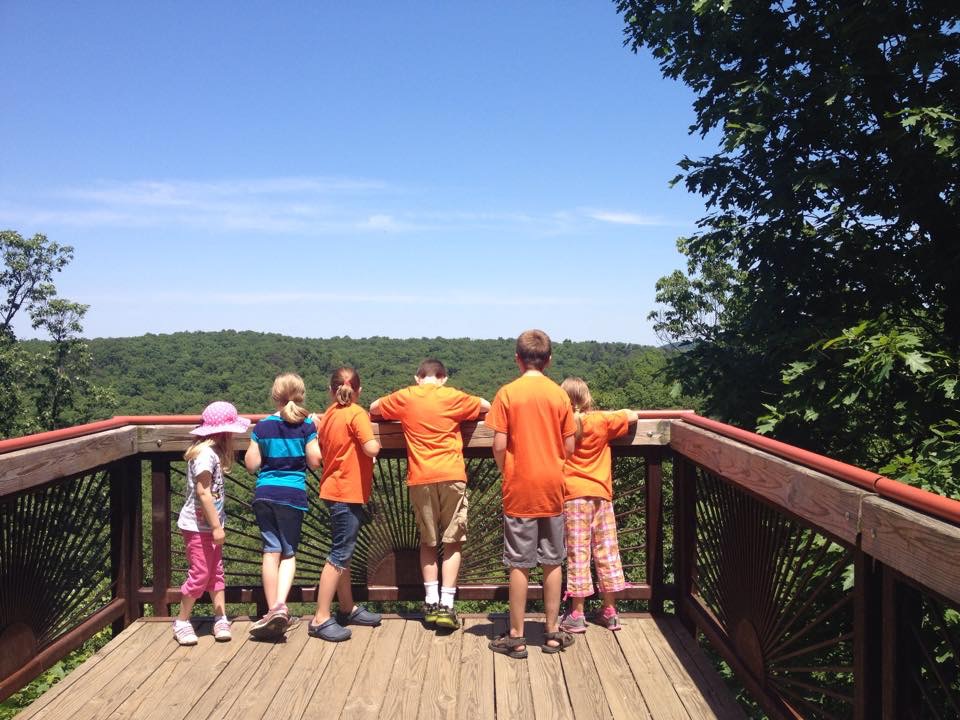 |
| Recent homeschool group trip to Bernheim Forest |
I'll try to work in some more Plutarch - we've stalled on Timoleon, as its the first full Life we've attempted. I regret that working in memory work, poetry and a few other riches isn't happening, but I am glad to have more time outside, with friends, and at the water park. A few weeks of relaxing and living a slower pace before all the therapies begin is just what the doctor ordered.
Besides, we have a new kitten, Moxie, and she needs "lots of lovins", I'm told.

June 17, 2015
WWW: Canterbury Tales
In AO year 7, the Canterbury Tales is one of the literature books scheduled. But not the original! Oh, no. You can almost always count on Ambleside Online to schedule the full, unabridged versions of classics, but this is one of the *very* few exceptions. Chaucer for Children or A Taste of Chaucer are the options in this case due to the bawdy nature of several of the original Tales.
Over at the AO Forum, we have been working our way through some year 7 books in the book discussion area, and today we finish Chaucer. I found a good deal on Malcolmson's A Taste of Chaucer, so have been reading it. It is written in verse, and is a fairly literal translation of the old English. I enjoyed the introduction and prologue in particular, as I didn't learn much about Chaucer or the Tales in my own schooling.

I think my favorite story was Chanticleer and the Fox (The Nun's Priest's Tale), as its about the only one that doesn't have men and women being mean to each other! A couple of the stories are incomplete for brevity's sake, or to avoid unnecessary cruelty in this children's edition. Chaucer's Tale: The Ballad of Sir Thopas was left incomplete in the original.
Here are the last two stanzas of Chanticleer's tale:
Lo, thus it is with those who are remiss
And negligent and trust in flattery.
But ye who think this tale a vanity
Told of a fox, or of a cock and hen,
Take to your hearts the moral, my good men.
For Saint Paul says that any written tale
Is for our guidance, is a parable.
Take you the wheat, and let the chaff lie still.
Now, God above, if that it be Thy will,
As prayed my Lord, so make us all good men
And bring us to His heavenly bliss. Amen!
May 8, 2015
Progress Report (AO4 Term 1)
We have just finished AmblesideOnline Year 4 Week 7. It was a lighter week of readings (on my modified 14 weeks per term schedule), which worked out great since I babysat a toddler a couple of days, had an afternoon of IQ testing (he finished this time!), and today is gymnastics day. He got extra computer time to practice coding (he gave up on Code Kingdom and is back at Code Academy), as well as math facts games, while I chased the toddler about. It was great fun for all of us, as a change of pace usually is.
The books this term are harder than what we have done in the past, but there are several he enjoys (Robinson Crusoe, The Storybook of Science, Minn of the Mississippi) and some that he groans about (Madame How and Lady Why, Age of Fable) but I have confidence that he will come to enjoy those in time. Pictures and videos help ease the pain! :) Carol has a great AO Pinterest board and I've been repinning her MHLW and Storybook of Science pins to my AO Year 4 board.

As it was the first week of a new month, we started the next folk song and hymn, which is always fun. I chose to do Jesus Loves Me, both in English and Spanish, to help prepare the Boy for his mission trip to Nicaragua (coming up in August!). The folk song is Pick a Bale of Cotton (see it towards the end of this playlist), and its incredibly catchy, and he was tapping and humming along with it after the first listen. Our artist this term is Degas, and the first painting was The Cotton Exchange, and the one we did the past two weeks was Place de la Concorde. He likes to fight me on art study, but does seem to have accepted that its this thing we do on Tuesdays. He considers it and listening to music a waste of time and doesn't see how its "school", but I think that might be the rigid thinking talking, that is so typical of Asperger's. (Still no diagnosis, but the paperwork is turned in and we are waiting on a phone call for an actual evaluation appointment.)

We will be schooling year round again, taking a couple weeks off here and there, so no real wind-down coming for us. I hope to find a good stopping point around Memorial Day so we can take our first break cleanly. Will you be making a hard stop for summer?
As you are winding down your school year, consider ramping up your household organization. Summer is a great time to reassess and make some changes for a fresh start before you start school again. Mystie is offering $15 off her Simplified Organization course for Mother's Day, so check it out! (Coupon code happymothers is good through Monday.)
The books this term are harder than what we have done in the past, but there are several he enjoys (Robinson Crusoe, The Storybook of Science, Minn of the Mississippi) and some that he groans about (Madame How and Lady Why, Age of Fable) but I have confidence that he will come to enjoy those in time. Pictures and videos help ease the pain! :) Carol has a great AO Pinterest board and I've been repinning her MHLW and Storybook of Science pins to my AO Year 4 board.
As it was the first week of a new month, we started the next folk song and hymn, which is always fun. I chose to do Jesus Loves Me, both in English and Spanish, to help prepare the Boy for his mission trip to Nicaragua (coming up in August!). The folk song is Pick a Bale of Cotton (see it towards the end of this playlist), and its incredibly catchy, and he was tapping and humming along with it after the first listen. Our artist this term is Degas, and the first painting was The Cotton Exchange, and the one we did the past two weeks was Place de la Concorde. He likes to fight me on art study, but does seem to have accepted that its this thing we do on Tuesdays. He considers it and listening to music a waste of time and doesn't see how its "school", but I think that might be the rigid thinking talking, that is so typical of Asperger's. (Still no diagnosis, but the paperwork is turned in and we are waiting on a phone call for an actual evaluation appointment.)
We will be schooling year round again, taking a couple weeks off here and there, so no real wind-down coming for us. I hope to find a good stopping point around Memorial Day so we can take our first break cleanly. Will you be making a hard stop for summer?
As you are winding down your school year, consider ramping up your household organization. Summer is a great time to reassess and make some changes for a fresh start before you start school again. Mystie is offering $15 off her Simplified Organization course for Mother's Day, so check it out! (Coupon code happymothers is good through Monday.)
April 27, 2015
Organization Details AO4
I've had some questions via social media on the details of my checklist, and I aim to please! In case you missed it, here is the initial post: How I've Organized AO Year 4.
I have a subject or two you won't have (Seeing Stars, or typing, for instance) and you won't see Latin on there yet, which AO prescribes for Year 4. But, you are welcome to take what you like and discard the rest. I intend on changing from Seeing Stars to Latin, and incorporating dictation in with copywork (using Simply Spelling) by the end of the year. Also, grammar may give way to Latin, depending on the program I choose.
I would like to just take the schedules on AO's website, print them and be done with the planning; maybe next year that will work. However, our reality is that school (meaning table work and readings) is done in four days most weeks to allow for appointments and homeschool outings. In addition, my son isn't up to speed as far as attention span and focus goes, so I have spread year 4 out over several more weeks that most will need to do.

With that said, this checklist is very simplified and can work, with slight modifications, for pretty much any elementary or maybe middle school year of AO (can't say, as I'm not there yet). I have saved it as a Google Sheet, which looked funny, so also have the PDF version (screen shot above). I'm slightly tech-challenged, so can't tell you if the PDF is editable or not, but the Sheet should be!
Below is what this lovely document looks like after being printed on our wonky laser printer (makes everything yellowish), stuffed in a sheet protector, and scribbled on with dry erase pencils. This was last week's page, and you can see that I made Tuesday the 21st our "optional" day, and scooted Wed-Fri to the day 2-4 slots. I didn't write the dates until I was ready to take the picture, and then only for record-keeping purposes. Giant X's means we skipped it, day 4 says "paint class" at the bottom. I filled in both the "nature study: draw" bubble and "handicrafts" bubble for that day for the paint class, as it was a pear. I used a different color pencil each day as well, so you can tell when things happened out of order. So there you go, in all its imperfect glory!

I have a subject or two you won't have (Seeing Stars, or typing, for instance) and you won't see Latin on there yet, which AO prescribes for Year 4. But, you are welcome to take what you like and discard the rest. I intend on changing from Seeing Stars to Latin, and incorporating dictation in with copywork (using Simply Spelling) by the end of the year. Also, grammar may give way to Latin, depending on the program I choose.
I would like to just take the schedules on AO's website, print them and be done with the planning; maybe next year that will work. However, our reality is that school (meaning table work and readings) is done in four days most weeks to allow for appointments and homeschool outings. In addition, my son isn't up to speed as far as attention span and focus goes, so I have spread year 4 out over several more weeks that most will need to do.
With that said, this checklist is very simplified and can work, with slight modifications, for pretty much any elementary or maybe middle school year of AO (can't say, as I'm not there yet). I have saved it as a Google Sheet, which looked funny, so also have the PDF version (screen shot above). I'm slightly tech-challenged, so can't tell you if the PDF is editable or not, but the Sheet should be!
Below is what this lovely document looks like after being printed on our wonky laser printer (makes everything yellowish), stuffed in a sheet protector, and scribbled on with dry erase pencils. This was last week's page, and you can see that I made Tuesday the 21st our "optional" day, and scooted Wed-Fri to the day 2-4 slots. I didn't write the dates until I was ready to take the picture, and then only for record-keeping purposes. Giant X's means we skipped it, day 4 says "paint class" at the bottom. I filled in both the "nature study: draw" bubble and "handicrafts" bubble for that day for the paint class, as it was a pear. I used a different color pencil each day as well, so you can tell when things happened out of order. So there you go, in all its imperfect glory!
April 11, 2015
How I've Organized AO Year 4
I tend to change the way I organize each school year - not really because it isn't working, but because I get bored with looking at the same. planning. pages. every. day. I also change notebooks around because they get full, or don't get used at all. Here are some changes I've made in the past month as we've eased into AO year 4.
I was using a paper planner for my week. I would look at my spreadsheet for the term, check we were on track for the week we were on, and fill in the blanks for each subject at the end of the previous week while everything was still fresh in my mind. I know many prefer Sunday evenings for this tasks, but by then I've forgotten what chapters we just read!
Anyway, I got tired of writing things down each week, so decided to print out the plans ahead of time. I took one sheet of my spreadsheet for just the readings. As you see below, I included the week number on the left, and five days in our week. I put day numbers instead of Monday through Friday, though, so if we have a difficult day or field trip somewhere, we can do "day 5" on that day, which is just free reads in the reading slots, and stay on track. This sheet is slid into a plastic page protector, so the markings you see are dry erase pencils. I started off not checking things, but it was hard to remember when he started wanting to skip around, so by the third week, I was marking each item. After week 4, I'll just print out the next part of the spreadsheet and can toss this one, or save for our physical records.

In the same page protector, on the other side, is the weekly sheet. Day 5 here is marked as optional, but we can usually get a few check bubbles filled, even when other activities are happening. I put the dates above for illustration purposes, and because I take a picture at the end of the 5 days for our records.
On the left is every single subject that we include in our homeschool. An X means we didn't get to it, and the numbers in the "Maths" row are the lesson numbers (he takes about 2 days per lesson). "DL" and "RS" in the "Spanish" row are DuoLingo and Rosetta Stone. By each "Read", I have a suggested subject, but they don't always work out exactly - we follow the list above. I placed Rosetta Stone on the same days as Typing and Singing, as all three of those are done on my computer, and I'd rather not have him on it often, but all at one shot.
I have a suggested focus area for Math Facts ($, addition/subtraction, and multiplication/division) but have not yet been consistent in this area. "Read aloud" means he reads to me a page or two from a school book or poetry, his choice. "Read alone" is reading a chapter in a simple chapter book to himself. All other readings I am still reading aloud, including Shakespeare (twice weekly) and Plutarch.
Hopefully you can see the balance. If he is going to play on the piano, its done after math to release tension that inevitably causes. We choose either timeline or map work, depending on what the readings that day ask for. I have daily subjects mostly at the top of the page, but I also have this in an order we can follow from top to bottom. We don't always go in that order, as I do let him choose, but if he's at a loss, I simply choose in this order. I tried to evenly spread the subjects that are once or twice a week out so that about the same time is necessary each day, except Day 5.

As you can see, we had a field trip and then a homeschool egg hunt in the same week, so things were skewed - it was a 3 day week, with day 4 completed this past Monday, April 6. (Then he got 4 days of spring break!) So, rather confusing, but it doesn't change the fact that we got it done, and always knew what was left to do! The nice thing about this list is that I can simply wipe it after taking the photo and be ready for the next week without having to write *anything* down, and he is able to take ownership of the bubble-filling, which is good for his confidence and fine motor skills.
Now, in addition to my one sheet wonder above, I do have some notebooks. We have a notebook just for math that we pull out daily, instead of a textbook and workbook. I have a Spanish notebook with a nice curriculum printed out in it, but we aren't currently using it. And then, I have a folder where I store art and music, which I'll say more about below, and a miscellaneous notebook where I store everything else, but only pull out about once a month.
This is what I started with - a place to keep the art prints when we were done with the artist. I would use one page protector for 2 art prints, so the 6 prints of a term took only 3 plastic protectors. It made for a nice little book, but the one inch binder was more than full after three years! I didn't have a good system for hymns and folk songs, and didn't always print out the lyrics, but only some of them. I took the ones from the past and put in the back of the folder above, then started anew.

I found a graphic online and wrote my own for the binder's edge, so it makes me want to look at it. :) Then I set to work on filling it. First, I gathered all the hymn and folk songs and artist's prints from the past and current term. I put the hymn facing forward, and the folk song facing backward in the same page protector, followed by a page of art prints. In Ambleside Online, there is a hymn and folk song scheduled each month, and 6 prints per 12-week term, so it works out great! This way, he can look back and see previous artwork and have his memory jogged by the music pages. Here's a couple pictures where I am trying to help you see what I'm talking about.


I hope that helps some of you! I realize that with multiple children, the bubbled checklist may take some tweaking, but I think if each child had their own it might work okay. I think you'd only need one Art & Music binder for the family, so it might work out as described, unless your children expect their own as keepsakes. What do you think?
I was using a paper planner for my week. I would look at my spreadsheet for the term, check we were on track for the week we were on, and fill in the blanks for each subject at the end of the previous week while everything was still fresh in my mind. I know many prefer Sunday evenings for this tasks, but by then I've forgotten what chapters we just read!
Anyway, I got tired of writing things down each week, so decided to print out the plans ahead of time. I took one sheet of my spreadsheet for just the readings. As you see below, I included the week number on the left, and five days in our week. I put day numbers instead of Monday through Friday, though, so if we have a difficult day or field trip somewhere, we can do "day 5" on that day, which is just free reads in the reading slots, and stay on track. This sheet is slid into a plastic page protector, so the markings you see are dry erase pencils. I started off not checking things, but it was hard to remember when he started wanting to skip around, so by the third week, I was marking each item. After week 4, I'll just print out the next part of the spreadsheet and can toss this one, or save for our physical records.
In the same page protector, on the other side, is the weekly sheet. Day 5 here is marked as optional, but we can usually get a few check bubbles filled, even when other activities are happening. I put the dates above for illustration purposes, and because I take a picture at the end of the 5 days for our records.
On the left is every single subject that we include in our homeschool. An X means we didn't get to it, and the numbers in the "Maths" row are the lesson numbers (he takes about 2 days per lesson). "DL" and "RS" in the "Spanish" row are DuoLingo and Rosetta Stone. By each "Read", I have a suggested subject, but they don't always work out exactly - we follow the list above. I placed Rosetta Stone on the same days as Typing and Singing, as all three of those are done on my computer, and I'd rather not have him on it often, but all at one shot.
I have a suggested focus area for Math Facts ($, addition/subtraction, and multiplication/division) but have not yet been consistent in this area. "Read aloud" means he reads to me a page or two from a school book or poetry, his choice. "Read alone" is reading a chapter in a simple chapter book to himself. All other readings I am still reading aloud, including Shakespeare (twice weekly) and Plutarch.
Hopefully you can see the balance. If he is going to play on the piano, its done after math to release tension that inevitably causes. We choose either timeline or map work, depending on what the readings that day ask for. I have daily subjects mostly at the top of the page, but I also have this in an order we can follow from top to bottom. We don't always go in that order, as I do let him choose, but if he's at a loss, I simply choose in this order. I tried to evenly spread the subjects that are once or twice a week out so that about the same time is necessary each day, except Day 5.
Now, in addition to my one sheet wonder above, I do have some notebooks. We have a notebook just for math that we pull out daily, instead of a textbook and workbook. I have a Spanish notebook with a nice curriculum printed out in it, but we aren't currently using it. And then, I have a folder where I store art and music, which I'll say more about below, and a miscellaneous notebook where I store everything else, but only pull out about once a month.
 |
April 8, 2015
Wednesday with Words: Tennyson Take 2
Last week I shared some of Tennyson's Idylls of the King. I have finished the epic poem, just as we began reading Tennyson as our poet for term one of AO year 4. I had read very little of him before, but after reading the Idylls and the first few of the AO chosen poems, I can say that I do like his style. So without further ado, here are a couple of my favorites so far, in honor of April being National Poetry Month. (Its also autism awareness month, occupational therapy appreciation month, and more, but I'll save that focus for another day!)
The Oak by Lord Alfred Tennyson
Live thy life,
Young and old,
Like yon oak,
Bright in spring,
Living gold;
Summer-rich
Then; and then
Autumn-changed,
Soberer hued
Gold again.
All his leaves
Fall'n at length,
Look, he stands,
Trunk and bough,
Naked strength.
I think I'm in the mid-to-late-summer of my life ;) but maybe he is really just talking about the tree...
I also liked this one, possibly because we have been watching a live web cam of eaglets hatching lately. (See the nest here.)
The Eagle
He clasps the crag with crooked hands;
Close to the sun in lonely lands,
Ring'd with the azure world, he stands.
The wrinkled sea beneath him crawls;
He watches from his m mountain walls,
And like a thunderbolt he falls.
April 2, 2015
30 Day Blog Challenge
Some AO ladies were lamenting about how they don't post on their blogs regularly, or that they are afraid we have nothing new/important/interesting/unique to say. I am in that camp some days. But no one else is me with my individual past, perspectives and current experiences, and no one else is you, either. :) Thus, the 30 day blog challenge was born. Each day in April (minus Sundays, so it is actually 26 days), I am committing to posting *something*. Hopefully that something will be interesting to someone other than me, but if nothing else, I will have a good record of this month!

Today we are working on week 3 of AO year 4. In addition, we are loading plastic Easter eggs for the homeschool gathering tomorrow, where I will read an Easter story, hide eggs for the kiddos, and some other moms will help with the dying (note: must remember to boil several eggs today).
We will be doing some more tidying up as well, since my parents will be in town this weekend. I'm hoping they will enjoy the community Easter pageant with me (I'm playing in the handbell choir), and the chorale singing on Sunday morning. We also plan on taking The Boy to an egg hunt Saturday that comes with a free spinal screening (this is sponsored by my chiropractor!).
Tonight my church is holding a Maundy Thursday service, with the choir singing some beautiful songs, if I do say so myself, followed by a short message and Lord's Supper (this is the Southern Baptist version of communion).
I hope you are enjoying your Holy Week!
Today we are working on week 3 of AO year 4. In addition, we are loading plastic Easter eggs for the homeschool gathering tomorrow, where I will read an Easter story, hide eggs for the kiddos, and some other moms will help with the dying (note: must remember to boil several eggs today).
We will be doing some more tidying up as well, since my parents will be in town this weekend. I'm hoping they will enjoy the community Easter pageant with me (I'm playing in the handbell choir), and the chorale singing on Sunday morning. We also plan on taking The Boy to an egg hunt Saturday that comes with a free spinal screening (this is sponsored by my chiropractor!).
Tonight my church is holding a Maundy Thursday service, with the choir singing some beautiful songs, if I do say so myself, followed by a short message and Lord's Supper (this is the Southern Baptist version of communion).
I hope you are enjoying your Holy Week!
March 18, 2015
Random Quotes
I'll take a break from Stepping Heavenward quotes and give you a pick at a few other words I've been pondering.
I don't remember where I found this one, but it was said by Micael Leunig.
My own pastor, a couple of Sunday's ago was preaching on prayer and came up with this one, from Exodus 33:12-23. Yes, it pretty much covers it all!
Over at the AO Forums, we completed reading Charlotte Mason's second volume, Parents and Children. I have so many highlights and notes from this reading! Here are a few of my favorites from chapter 25.
"The cure for anything is saltwater: sweat, tears, or the sea." -isak dinesenIsn't that great?! I love it. Found that on Facebook. :) As you can see from the next quote, I have been doing some reading on minimalism as I declutter. Its such a good feeling to see clear, flat spaces again, and to get rid of things I no longer need or even want.
"It's ironic but true: a minimalist lifestyle leads to a broader, more varied life." - The Minimalist Lifestyle
 |
| First signs of spring - bit of green on the trees along the creek |
I don't remember where I found this one, but it was said by Micael Leunig.
"Love one another and you will be happy. It's as simple and as difficult as that."
 |
| Jump into spring ;) |
"Lord, help me to know You; help me to walk in Your presence; reveal to me Your glory."
 |
| First daffodils of the year |
"...the Divine Spirit does not work with nouns of multitude, but with each single child." pg. 273
"...let her [the mother/teacher] never contemplate any kind of instruction for her child, except under the sense of the divine cooperation." -pg. 274
"...children must have books, giving books; the best are not too good for them; anything less than the best is not good enough; and if it be needful to exercise economy, let go everything that belongs to soft and luxurious living before letting go they duty of supplying the books, which are necessary for the constant stimulation of the child's intellectual life." -pg. 280
March 6, 2015
Time for Exams!!
I don't think I've written about our school exams before. Ambleside Online posted exam questions for each term of each year a couple of years ago, and I hadn't gotten my head wrapped around this whole CM education thing well enough before that do try it on my own, so he had no exams in year 1 and part of year 2. The first time we did exams was a learning experience for us both, but he has learned to look forward to these light days. The excitement of seeing what he remembers, getting to draw it, record himself and show it to Daddy makes for smooth and easy days. :)
Here is AO's suggested exam questions for yr 3.5, term 2, which we will be doing this afternoon and Monday (you can spread it out over a whole week, but at this age, it doesn't seem necessary). As I rearranged some of the books, mine won't look just like that, but I am SO thankful that the initial work has been done. Even when I followed the plan in year 3 exactly, I still had to tweak a few of the questions and simplify some things, so don't be afraid to make these exams your own, just as you do the curriculum. One size does not fit all!
Here is our Year 3 Term 2 exam, from right about a year ago.
Here are his exam questions and results from term 1 of his 4th grade. There was quite a bit improvement between this and the one linked above. The thing to remember about doing an exam the Charlotte Mason way is that it isn't about getting everything right. Its about seeing what is retained, and I as the teacher determining what can be changed in order for him to remember more. Answering open-ended types of questions if much more difficult than multiple choice and true or false. Starting at a young age means the mental strength for essay questions is developed all along, making speaking and writing more fluent in later years.
In addition to what I transcribed in those files, I also recorded, or at least listened to, his read-aloud and recitation (poetry, Bible verses). I keep it as light and fun as we can, and so far it has been amazing how different his attitude is towards exams verses those of public school (dread, eye-rolling, stress). Let's hope it stays positive for many more years.
So how do you do exam time in your home? Do the kids love it or loathe it?
Here is AO's suggested exam questions for yr 3.5, term 2, which we will be doing this afternoon and Monday (you can spread it out over a whole week, but at this age, it doesn't seem necessary). As I rearranged some of the books, mine won't look just like that, but I am SO thankful that the initial work has been done. Even when I followed the plan in year 3 exactly, I still had to tweak a few of the questions and simplify some things, so don't be afraid to make these exams your own, just as you do the curriculum. One size does not fit all!
Here is our Year 3 Term 2 exam, from right about a year ago.
Here are his exam questions and results from term 1 of his 4th grade. There was quite a bit improvement between this and the one linked above. The thing to remember about doing an exam the Charlotte Mason way is that it isn't about getting everything right. Its about seeing what is retained, and I as the teacher determining what can be changed in order for him to remember more. Answering open-ended types of questions if much more difficult than multiple choice and true or false. Starting at a young age means the mental strength for essay questions is developed all along, making speaking and writing more fluent in later years.
 |
| Example of a drawn narration, which he then describes aloud |
So how do you do exam time in your home? Do the kids love it or loathe it?
Subscribe to:
Posts (Atom)